More Traffic Won’t Fix a Broken Conversion System
Getting attention is only the beginning. What happens next determines whether marketing becomes revenue.
How much revenue is already sitting inside your pipeline?
Getting more website traffic sounds like the obvious answer when a service business wants to grow.
More people finding the business should mean more leads. More leads should mean more customers. More customers should mean more revenue.
But that equation only works when the system between attention and revenue works.
If prospects are already visiting your website, calling your business, submitting forms, requesting estimates, or interacting with your Google Business Profile, increasing traffic may simply send more opportunities into a system that isn’t converting them effectively.
That creates an expensive problem.
Instead of fixing the conversion system, the business keeps paying to feed it.
Traffic Is Only the Beginning
SEO, paid advertising, social media, local search, and other marketing channels are designed to create attention and demand.
That matters. Without visibility, potential customers may never discover your business.
But traffic itself isn’t the business outcome.
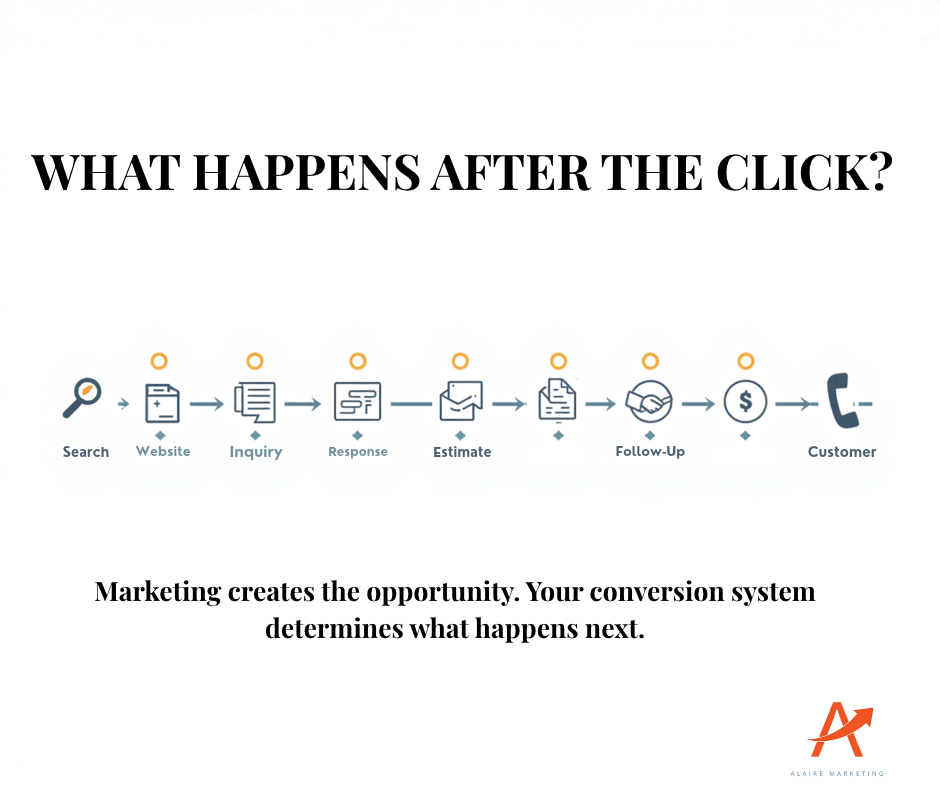
A website visitor still has to understand what you do, trust your company, take action, receive a response, move through the sales process, and ultimately become a customer.
There are multiple opportunities for that journey to break down.
A prospect may land on the website and leave because the next step isn't clear.
Someone may submit a form and wait too long for a response.
A caller may reach voicemail and contact the next company.
An estimate may be delivered but never followed up.
The marketing worked. The opportunity existed.
The conversion system failed to carry it forward.
More Leads Can Magnify an Existing Problem
Consider two hypothetical service businesses.
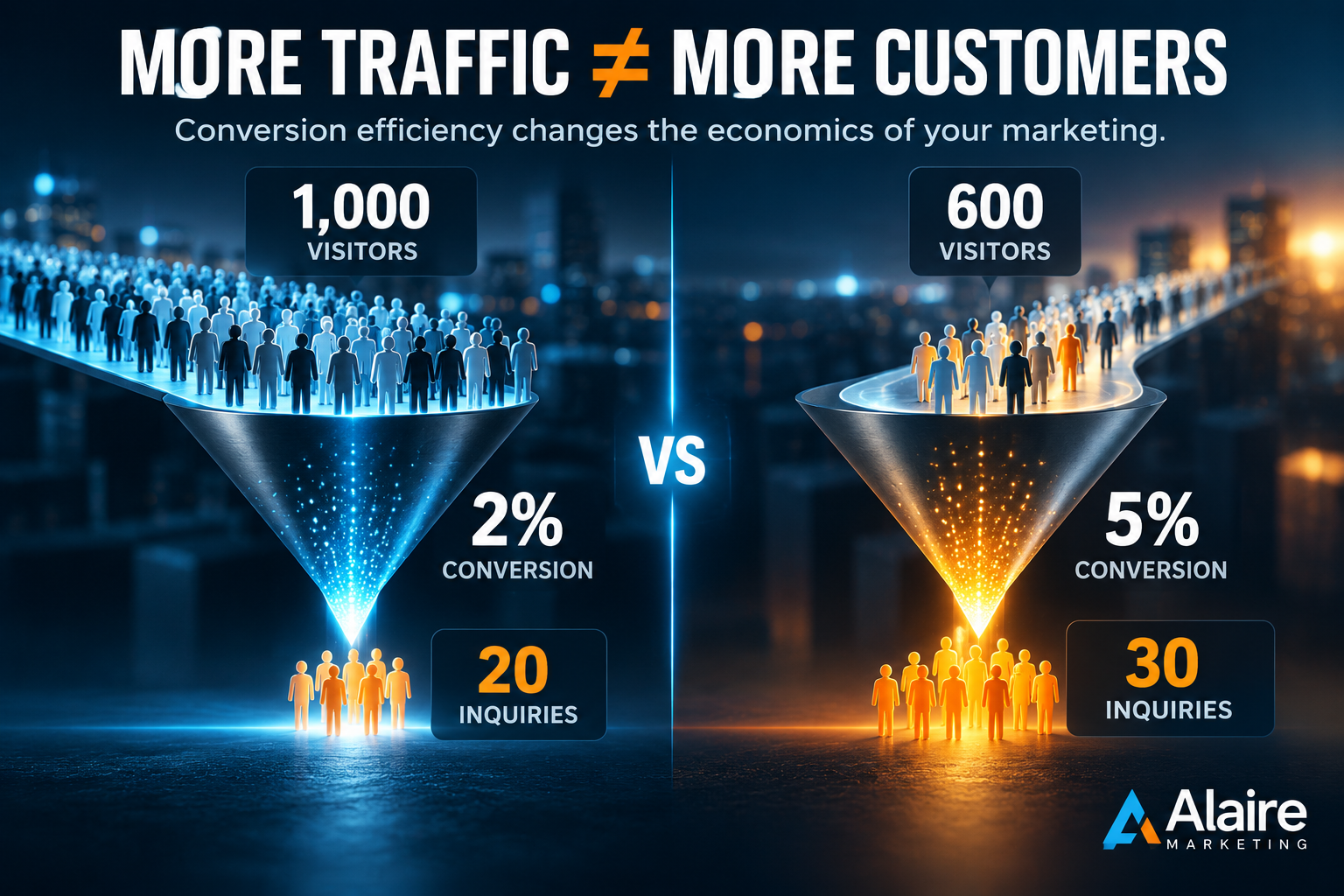
Business A generates 1,000 website visitors and converts 2% into qualified inquiries.
Business B generates only 600 visitors but converts 5%.
Business A produces 20 inquiries.
Business B produces 30.
The company with substantially less traffic produces more opportunities because it converts existing attention more effectively.
Now imagine Business A responds slowly to those 20 inquiries and has inconsistent estimate follow-up.
Its actual customer count falls even further.
This is why simply increasing an advertising budget or chasing additional website traffic can be the wrong first move.
More traffic entering a weak conversion system can create more waste, not proportionally more revenue.
Look at What Happens Between the Click and the Customer
Marketing reports often concentrate heavily on the top of the customer journey:
Impressions. Rankings. Clicks. Website sessions. Cost per click. Form submissions.
Those metrics help diagnose marketing performance, but they don't tell the entire story.
Service businesses also need visibility into what happens next.
How many website visitors become legitimate inquiries?
How many calls are answered?
How quickly are web leads contacted?
How many inquiries become appointments or estimates?
How consistently are open estimates followed up?
How many opportunities become paying customers?
And eventually: which marketing sources produced actual revenue?
When those stages aren't connected, a business can know a great deal about its marketing activity while knowing surprisingly little about how effectively that activity becomes revenue.
Conversion Problems Aren't Just Website Problems
Conversion rate optimization is often treated as a website discipline: improve a headline, move a button, shorten a form, change a landing page.
Those things can matter.
But for a service business, conversion happens across a much larger system.
Your website has to create enough trust for someone to contact you.
Your phone and form processes have to make contacting you easy.
Your team has to respond while customer intent is still high.
Your sales process has to move the opportunity forward.
Your follow-up system has to prevent viable opportunities from quietly disappearing.
Your CRM or tracking process has to provide visibility into what happened.
A beautifully optimized website cannot compensate for a lead that waits two days for a response.
Likewise, excellent phone handling cannot rescue a website that gives prospects no reason to make the call.
Conversion is a system, not a button.
Fix the System Before You Feed It More Traffic
This doesn't mean service businesses should stop investing in SEO, advertising, local search, or other forms of lead generation.
Quite the opposite.
Marketing becomes more valuable when the infrastructure behind it can convert the demand it creates.
Before increasing acquisition spend, examine the entire path from first interaction to customer.
Where do prospects hesitate?
Where do they wait?
Where does responsibility become unclear?
Where does follow-up stop?
Where does tracking disappear?
Those friction points deserve attention because every improvement can increase the value of traffic you're already generating.
Then, when you increase traffic, you're scaling a stronger system instead of amplifying an inefficient one.
Marketing Shouldn't Stop at the Lead
This is where Alaire's approach differs from the traditional agency model.
SEO, websites, local visibility, paid campaigns, and other marketing services remain critical tools for generating demand.
But generating activity isn't enough.
Alaire doesn't just generate marketing activity. We build and improve the systems that turn attention into customers and customers into measurable revenue.
In other words:
We still do the marketing. We just don't stop there.
Because the real question isn't simply how many people visited, clicked, called, or filled out a form.
It's what happened next.
From Marketing Activity to Measurable Revenue
We still do the marketing. We just don't stop there.
Because the real question isn't simply how many people visited, clicked, called, or filled out a form.
It's what happened next.
Did the lead get captured? Was there a fast response? Did the opportunity move forward? Was follow-up consistent? Can you track what converted—and connect it back to revenue?
That's the gap Revenue Control™ is designed to address.
Revenue Control™ brings together lead generation, response, follow-up, tracking, conversion, and optimization into a structured system for turning demand into predictable revenue.
Because generating more demand is only valuable when your business has the systems to capture and convert it.
More traffic isn't the goal. More leads aren't the goal.
The goal is turning the attention you've earned into customers and measurable revenue—and having the control to do it consistently.