
Your Customer Journey Is Costing You Sales: Where Conversion Friction Hides
Customers rarely disappear for no reason. Somewhere along the journey, continuing became harder than leaving.
Businesses spend enormous amounts of time trying to get prospective customers to notice them.
SEO.
Advertising.
Social media.
Email.
Content.
Referrals.
All of those activities can create attention and generate opportunities.
But acquiring someone's attention is only the beginning.
Once a prospective customer decides to contact your business, an entirely different system takes over.
And that system may have far more influence on revenue than most businesses realize.
A prospective customer might:
Search for a solution.
Visit your website.
Call your business.
Submit a form.
Request an estimate.
Ask a question.
Compare options.
Wait for a response.
Receive a proposal.
Consider the decision.
Need additional information.
Wait for someone to follow up.
And eventually—maybe—become a customer.
Every one of those transitions creates an opportunity for the relationship to move forward.
It also creates an opportunity for it to stop.
That is where conversion friction enters the customer journey.
What Is Conversion Friction?
Conversion friction is anything that makes it unnecessarily difficult for a prospective customer to take the next step.
Sometimes that friction is obvious.
A broken contact form.
A phone that goes unanswered.
A confusing website.
An estimate that never gets sent.
But much of the friction inside a service business is considerably less visible.
The customer submits a form and waits three hours for a response.
Someone calls while the team is busy and reaches voicemail.
An estimate is delivered but nobody follows up.
A prospect asks a question and waits until the following morning for an answer.
An inquiry gets transferred between employees without clear ownership.
A potential customer doesn't understand what happens after requesting service.
None of these events necessarily look catastrophic on their own.
Collectively, however, they can have a significant effect on conversion.
Customers Experience One Journey. Businesses Often Operate Several Disconnected Processes.
This distinction matters.
Inside the company, marketing may be one function.
Phone answering may be another.
Scheduling may happen somewhere else.
Estimates may belong to sales.
Follow-up may depend on an individual employee.
Customer information may live in a CRM—or in several systems.
To the customer, none of those organizational boundaries exist.
They experience one business.
One journey.
One interaction after another.
When those interactions don't connect smoothly, the customer experiences the gaps between your systems.
And those gaps create friction.
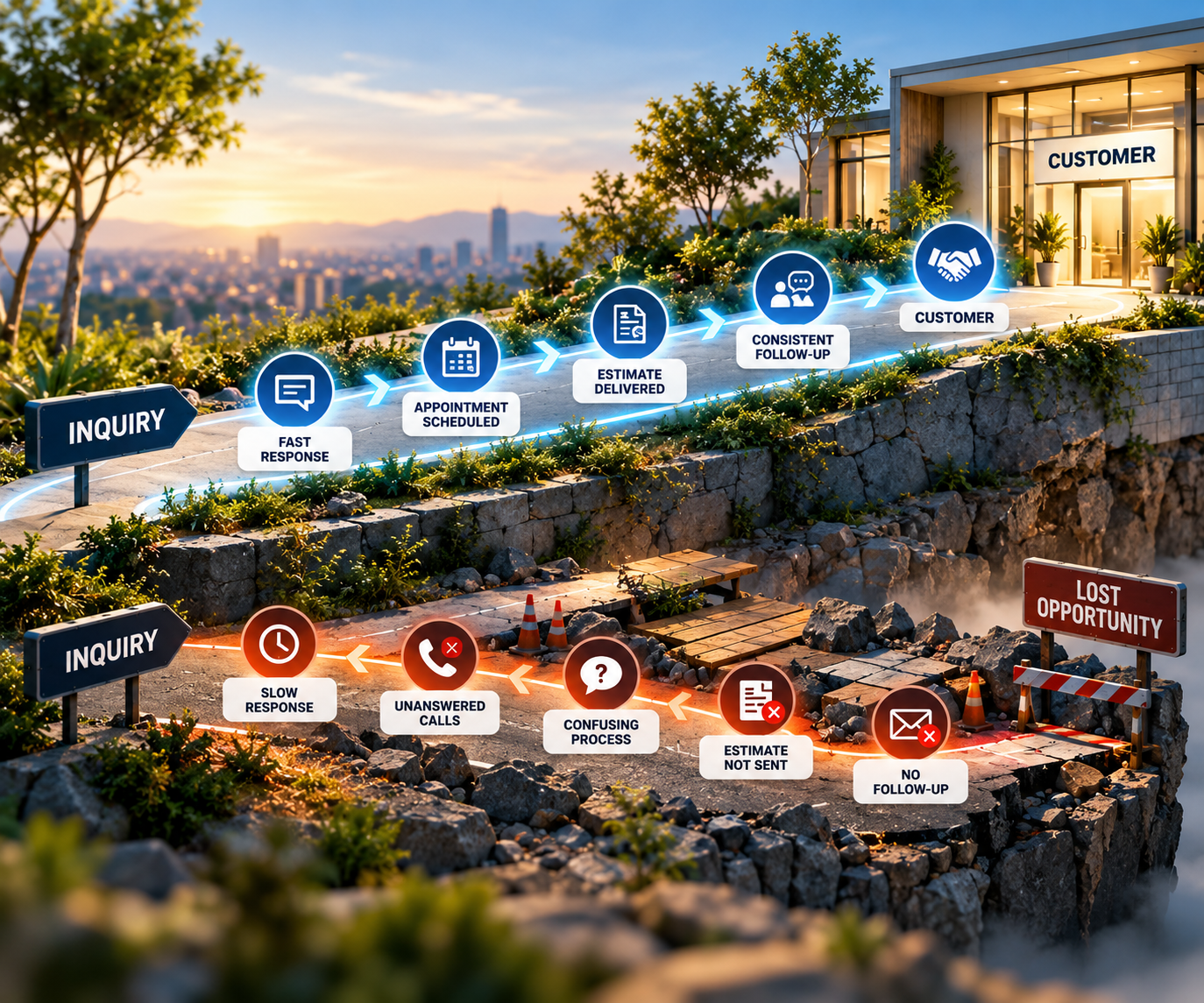
The Customer Journey Doesn't End at the Lead
A common marketing model looks something like this:
Traffic → Lead
But the actual revenue journey is much longer.
For many service businesses, it looks more like:
Search → Website → Inquiry → Response → Conversation → Estimate → Follow-Up → Decision → Customer
Marketing influences the beginning of that journey.
Revenue depends on the entire thing.
That is why measuring only traffic, clicks, calls, or form submissions provides an incomplete picture of growth.
A business could generate more inquiries every month while still losing substantial opportunity downstream.
Friction Point #1: The Website-to-Inquiry Gap
Someone has found your business.
Now they have to decide whether contacting you feels worthwhile.
At this stage, prospects are often asking themselves questions they may never say out loud:
Does this company actually provide what I need?
Do they work with customers like me?
Can I trust them?
How quickly can I get help?
What happens after I contact them?
Is this going to become a sales hassle?
If your website creates uncertainty rather than resolving it, some prospective customers will simply continue searching.
The job of the website isn't merely to attract visitors.
It should help qualified prospects confidently take the next step.
Friction Point #2: The Inquiry-to-Response Gap
The customer takes action.
They call.
They submit the form.
They send the message.
From the customer's perspective, the clock has started.
Their problem hasn't disappeared while your team finishes another appointment, gets through lunch, closes for the evening, or catches up the following morning.
Intent has a shelf life.
The longer the delay between inquiry and meaningful response, the more opportunity there is for the prospect to continue searching, contact another provider, or simply lose momentum.
This doesn't mean every business must operate a staffed call center around the clock.
It means the business needs a deliberate response system.
Friction Point #3: The Conversation-to-Estimate Gap
Receiving an inquiry isn't the same as creating a sales opportunity.
The next stage has to move the customer toward a decision.
What information is collected?
Who owns the opportunity?
What happens next?
Does the customer know?
Is an appointment scheduled?
Is an estimate required?
When should they expect it?
Ambiguity creates friction.
A strong conversion system makes the next step obvious both internally and to the customer.
Friction Point #4: The Estimate-to-Decision Gap
This is one of the easiest places for revenue to disappear quietly.
The estimate gets delivered.
Then everyone waits.
The business assumes the customer will call when they're ready.
The customer gets busy.
Another provider follows up.
Priorities change.
Questions remain unanswered.
The opportunity becomes older.
Eventually the estimate is treated as lost even though nobody actually determined why the customer didn't move forward.
An estimate is not the end of the sales process.
For many businesses, it is the beginning of the decision process.
Friction Point #5: Inconsistent Follow-Up
Follow-up is frequently treated as an employee behavior rather than a business system.
One person follows up consistently.
Another remembers when things slow down.
Someone else assumes the prospect isn't interested.
Another doesn't want to be pushy.
The result is an unpredictable customer experience.
Good follow-up does not mean endlessly chasing people.
It means creating a deliberate communication process that helps qualified prospects continue making a decision.
That may include:
Answering outstanding questions.
Providing useful information.
Confirming next steps.
Checking whether circumstances changed.
Making it easy to re-engage.
Closing the loop when the opportunity is no longer active.
Consistency creates visibility.
Without it, opportunities simply age.
Friction Point #6: Nobody Can See the Entire Journey
This may be the most important problem of all.
A business cannot systematically improve a journey it cannot see.
Ask:
How many inquiries came in?
Where did they come from?
How quickly were they contacted?
How many became appointments?
How many received estimates?
How many estimates remain open?
How many required follow-up?
How many became customers?
How long did conversion take?
Where did the others stop?
If those answers live in several systems—or aren't available at all—management is forced to make growth decisions with incomplete information.
And that often sends the business back to the easiest lever to pull:
Generate more leads.
But more leads don't automatically fix friction.
They simply send more people through the same journey.
The Goal Isn't a Perfect Customer Journey
No system converts every opportunity.
Nor should it.
Some prospects aren't qualified.
Some aren't ready.
Some will choose another provider.
Some projects won't be a fit.
Customer journey optimization isn't about eliminating every lost opportunity.
It is about eliminating avoidable loss.
There is an important difference.
A business should be able to distinguish between:
A customer who consciously chose not to buy
and
An opportunity the business unintentionally allowed to disappear.
Without visibility into the journey, those two outcomes often look exactly the same.
Start With the Handoffs
If you want to identify friction, don't begin by redesigning everything.
Examine the handoffs.
Traffic → Website
Does the message match what brought the visitor there?
Website → Inquiry
Is taking action obvious and easy?
Inquiry → Response
How quickly does meaningful contact happen?
Response → Opportunity
Is there a defined next step?
Opportunity → Estimate
Is ownership clear?
Estimate → Follow-Up
Is there a consistent process?
Follow-Up → Decision
Can the outcome be measured?
The handoffs reveal where momentum is being lost.
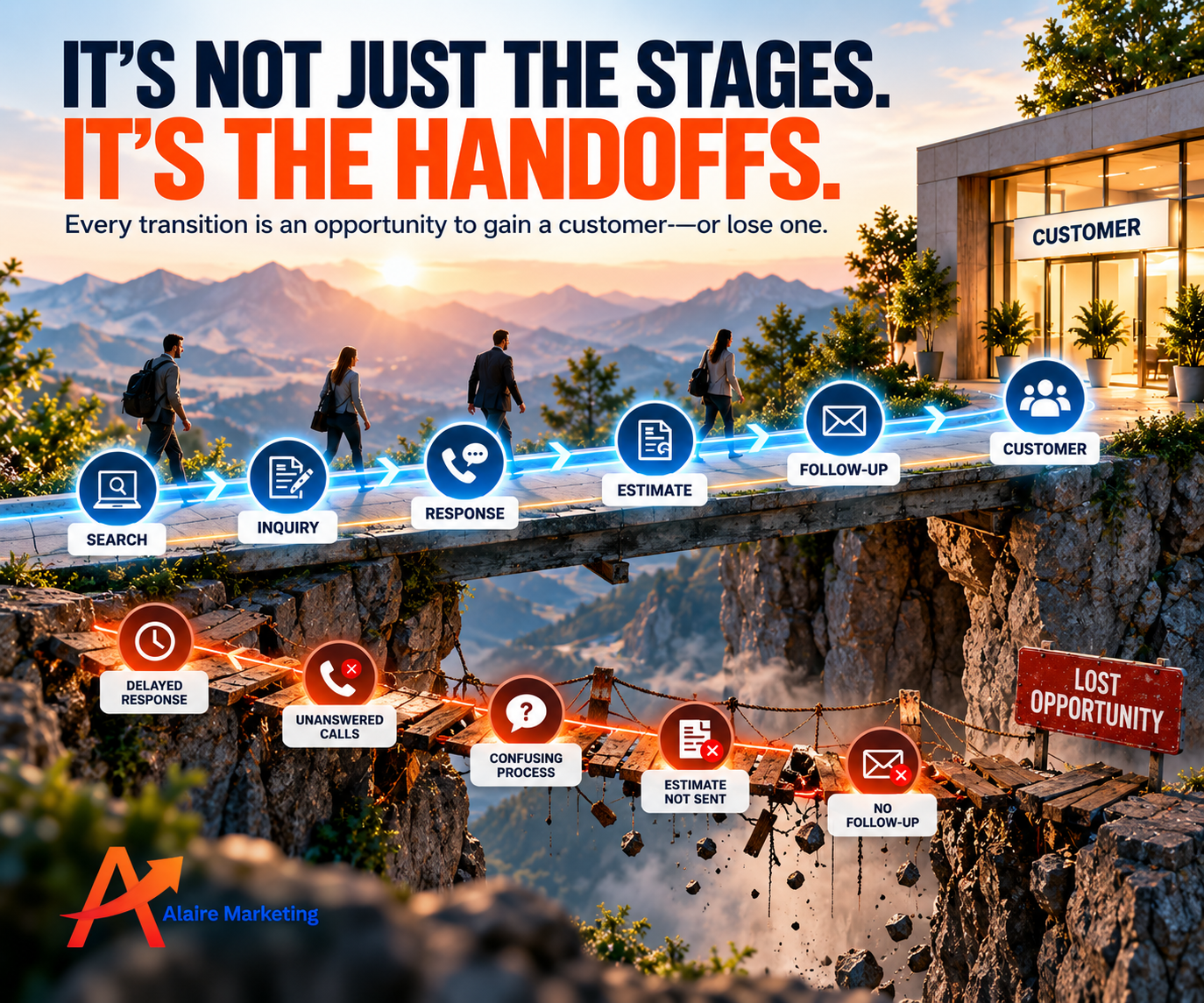
Marketing and Conversion Shouldn't Operate as Separate Systems
Marketing creates attention.
The customer journey turns that attention into action.
The sales process turns action into decisions.
Tracking tells you what ultimately became revenue.
When those functions operate independently, growth becomes difficult to diagnose.
Marketing can report leads while sales says the leads aren't converting.
Sales can blame lead quality while marketing points to increasing inquiry volume.
Management sees activity but cannot clearly connect that activity to revenue.
The problem isn't necessarily either team.
The problem may be the system connecting them.
Growth Becomes Easier When the Journey Becomes Visible
You don't need another dashboard simply for the sake of having more data.
You need enough visibility to answer practical business questions.
Where are opportunities entering?
Where are they stopping?
How quickly are they moving?
Which sources create customers rather than merely leads?
Which stage deserves improvement first?
Once those questions become answerable, growth decisions become much more precise.
You can determine whether you actually need:
More traffic.
A better website.
Faster response.
Better qualification.
Stronger follow-up.
A clearer sales process.
Improved tracking.
Or some combination of them.
That's very different from assuming every growth problem requires more marketing.

Build the System That Connects Marketing to Revenue
Marketing should create opportunity.
But what happens after that opportunity arrives determines how much of that demand ultimately becomes revenue.
That's why Alaire Marketing doesn't treat lead generation, response, follow-up, conversion, and measurement as unrelated activities.
They are parts of the same revenue system.
Revenue Control™ connects the customer journey—from demand generation through conversion and revenue visibility—so you can understand what is working, where opportunities are slowing down, and what should be improved next.
If your business is generating attention but the path from inquiry to customer isn't consistently visible, the next step isn't automatically another campaign.
It may be building better control over the journey you already have.
Explore the Revenue Control™ System → [Revenue Control URL]